Backstreet Journey

Tokyo

Tokyo Station

The east side of the station is called Yaesu, after a Dutch sailor. The name belonged to the west side until 1929, disappeared, and came back in 1954 on the other side of the tracks.

Tokyo Station opened in 1914 and still stands behind the red brick front that Tatsuno Kingo designed for it. The Marunouchi side faces the Imperial Palace across a straight ceremonial avenue; the Yaesu side is a wall of towers and an underground town of shops. Most people pass through in minutes. The things worth stopping for — a ceiling with eight zodiac animals, a silver bell that a station employee made out of bamboo and paper, two plaques marking where prime ministers were attacked — are all within a few minutes of the ticket gates.

Sightseeing

The Classics

Marunouchi Station Building

Marunouchi Station Building

2min walk

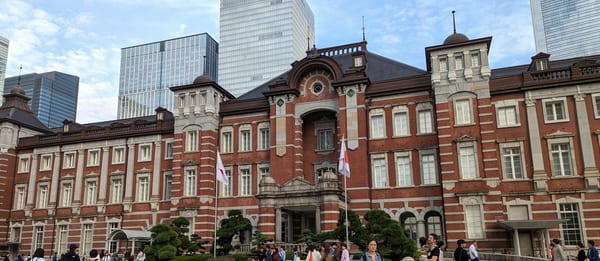
The red brick front of the station, designed by Tatsuno Kingo and completed in 1914. Air raids in 1945 destroyed the north and south domes and the third floor, and for over sixty years the building carried a makeshift octagonal roof. It was restored to its original shape in 2012. The building has been an Important Cultural Property since 2003.

💡 The best place to see the whole facade is the plaza on the Marunouchi side, or from above at KITTE or the Shin-Marunouchi Building. It is lit until 21:00.

Imperial Palace Outer Garden and Nijubashi

Imperial Palace Outer Garden and Nijubashi

20min walk

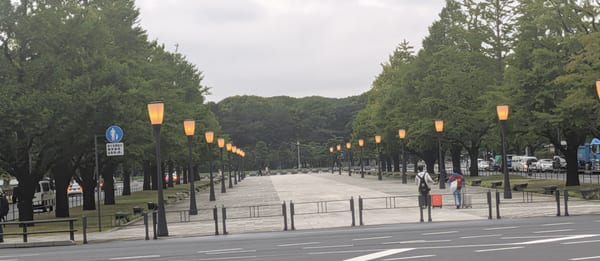
Walk straight down Gyoko-dori from the Marunouchi exit and the avenue ends at the moat. The outer garden is open ground with black pines, and beyond it stands Nijubashi, the double bridge in front of the palace gate. The grounds inside are closed except on two days a year.

💡 The two open days are 2 January and 23 February, the Emperor's birthday. The Inui-dori avenue inside the grounds also opens for about nine days each spring and autumn.

Tokyo Station Ichibangai

3min walk

An underground shopping street of about a hundred shops, connected directly to the Yaesu underground central gate. Three named blocks sit in it: Ramen Street, Character Street, which gathers the official shops of Japanese television and game characters, and Okashi Land, run by confectionery makers.

💡 It is underground and on the Yaesu side, so people who come out of the Marunouchi exit for the brick facade never pass through it.

Local Secrets

The eight zodiac animals in the dome

The eight zodiac animals in the dome

2min walk

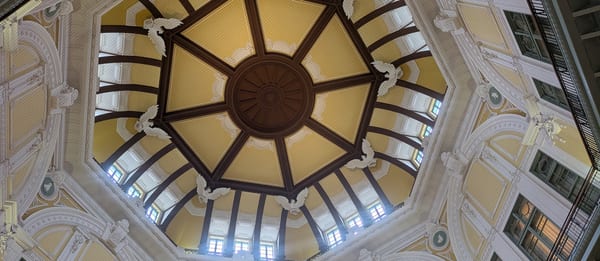
Eight reliefs of zodiac animals sit in the corners of the restored domes, each placed at the compass point it stands for. Four are missing: the rat for north, the rabbit for east, the horse for south and the rooster for west. The domes are octagonal, so only the eight diagonal directions had a corner to put an animal in.

💡 Both the north and south domes have them. You do not need a ticket — the domes are outside the gates, above the Marunouchi north and south exits.

The Silver Bell

2min walk

The station's meeting point, hung on 10 June 1968. A station supervisor named Sekiguchi Yonosuke suggested a large shrine bell, because bells have always been used to call people and catch attention. Staff made the first one themselves out of bamboo, washi paper and silver foil, about 70cm across. The one hanging now is the fourth, put up in October 2007 when the Gransta shopping floor opened.

💡 It is inside the gates, on the basement floor. If you are not travelling you cannot reach it without a platform ticket.

Two plaques where prime ministers were attacked

2min walk

On 4 November 1921 Hara Takashi was stabbed near the ticket gates at what is now the Marunouchi south exit. On 14 November 1930 Hamaguchi Osachi was shot on platform 4; he died of the wounds the following year. Plaques mark both spots, set into the floor where people walk past them all day.

💡 The Hara plaque is outside the gates and anyone can see it. The Hamaguchi one is on the platform, by the central staircase, so you need a ticket.

KITTE Garden

KITTE Garden

4min walk

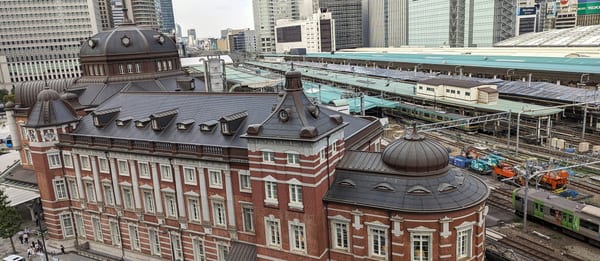
A roof garden of about 1,500 square metres on the sixth floor of KITTE, the building across from the Marunouchi south exit. It opened with the building in March 2013. From the edge you look down on the brick station roof and straight along the platforms.

💡 Free, and open until 23:00 on weekdays and 22:00 at weekends and holidays. The station is lit until 21:00, so the hour before that is the one to aim for.

The terrace on the 7th floor of the Shin-Marunouchi Building

5min walk

A terrace on the restaurant floor, open to about 180 degrees on the station side. You can walk out and sit at a table without ordering anything. It faces the brick facade head on, at about the height of the roof.

💡 Open until 23:00, and the station is lit until 21:00. There are chairs and tables, which the KITTE roof does not have.

Tokyo Station Gallery

3min walk

A museum opened in 1988 inside the station building itself, by the Marunouchi north exit. The restoration left the original structure exposed where it could, so the gallery walls are bare brick and steel from 1914. The building around them is an Important Cultural Property.

💡 The exhibitions change, but the walls are the reason to go in. The staircase down from the top floor runs along the inside of the dome.

Marunouchi Nakadori

Marunouchi Nakadori

6min walk

The street that runs parallel to the tracks on the palace side, about 1.2km of it, lined with roughly 250 street trees. Cars are kept out for part of the day and tables come out onto the pavement. It is the one place in this district that is built for walking rather than for getting somewhere.

💡 From mid-November to mid-February the trees are lit in champagne gold. It is also the quietest part of Marunouchi at the weekend, when the office towers empty out.

Food & Drink

The Classics

Tokyo Ramen Street

3min walk

Ten ramen shops in a row on the basement floor of Tokyo Station Ichibangai, each a branch of a shop with its own following elsewhere in the city. The styles do not overlap, so the row works as a way to compare them in one place.

💡 Queues form at lunch and again after seven. Between two and four in the afternoon most of the ten have seats.

Ekibenya Matsuri

1min walk

A shop inside the gates that sells over 150 kinds of ekiben, the boxed meals made for train journeys, gathered from Hokkaido to Kyushu. It moves ten thousand boxes on a weekday and fifteen thousand at weekends. Opens at 5:30 in the morning.

💡 The regional boxes sell out first, often before noon. Buying one and eating it on the train is the point; there is nowhere comfortable to eat it in the station.

The Memory of This Town

The station where two prime ministers were attacked

Tokyo Station opened on 20 December 1914, with a brick front by Tatsuno Kingo that ran three hundred metres along the Marunouchi side.

On 4 November 1921, Hara Takashi, the first commoner to serve as prime minister, was walking towards the ticket gates on his way to a party convention. A young railway switchman named Nakaoka Konichi stabbed him there. Nine years later, on 14 November 1930, Hamaguchi Osachi was shot on platform 4. He survived the day and died of the wounds the following year.

In 1945 the air raids took the north and south domes and the third floor. The station kept working. A makeshift octagonal roof went up over the ruined domes, and it stayed there for over sixty years — long enough that a generation grew up thinking that was what the station looked like.

The restoration finished in October 2012. The domes went back to their original shape, and the zodiac reliefs were remade from surviving records and chemical analysis of the fragments.

  • Plaques mark both attacks: Hara's outside the gates at the Marunouchi south exit, Hamaguchi's on platform 4 by the central staircase.
  • The building has been an Important Cultural Property since 2003.

Through the Year

  1. Jan2 January

    New Year public greeting

    Imperial Palace, inner grounds

    One of only two days a year when the palace gates open and people cross the bridges into the inner grounds. The imperial family appears on the palace balcony several times through the morning. The other day is 23 February, the Emperor's birthday.

  2. NovMid-November to mid-February

    Marunouchi Illumination

    Marunouchi Nakadori and Gyoko-dori

    About 250 street trees along the 1.2km of Nakadori are lit in champagne gold. For about four weeks from late November, roughly 36,000 lights are also strung along part of Gyoko-dori, the avenue between the station and the palace.

  3. NovAbout nine days from late November

    Inui-dori public opening

    Inui-dori, inside the Imperial Palace

    The avenue that runs through the palace grounds is opened to the public for about nine days in autumn, and again in spring for the cherry blossom. These are among the few days when anyone can walk inside the moat.

Dates shift from year to year. Check the shrine or organiser before you plan around one.

Where to Stay

The Tokyo Station Hotel

The Tokyo Station Hotel

2min walk

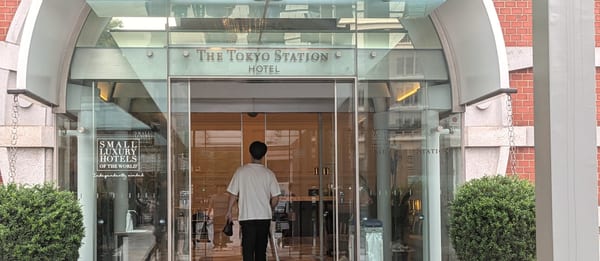
A hotel inside the station building, opened on 2 November 1915 with 56 rooms. It closed for the restoration work and reopened on 3 October 2012, now with 150 rooms. The building it occupies is an Important Cultural Property, so guests sleep inside a designated monument.

About 60,000–150,000 yen a night

Bulgari Hotel Tokyo

5min walk

Opened in 2023 on the top floors of Tokyo Midtown Yaesu, this is Bulgari’s most architecturally striking property, designed with deep references to Japanese wabi-sabi aesthetics. Il Ristorante – Niko Romito serves exceptional Italian cuisine, and the spa is among the finest in the city.

From approx. ¥200,000/night; expect considerably more for suites and peak season.

Getting to Tokyo Station

  • From Shibuya

    25 min · direct · JR Yamanote Line · ¥260Take the outer loop, which goes around by Shinagawa. The inner loop goes the long way through Shinjuku and Ikebukuro. Changing from the Ginza Line to the Marunouchi Line takes 17 minutes but adds a transfer.

  • From Shinjuku

    14 min · direct · JR Chuo Line Rapid · ¥260Tokyo is the end of the line for the Chuo Rapid, so there is no risk of missing the stop.

  • From Ikebukuro

    17 min · direct · Tokyo Metro Marunouchi Line · ¥210The Marunouchi Line runs straight into the basement of the station. The JR Yamanote outer loop also works, in 24 minutes.

  • From Ueno

    7 min · direct · JR Keihin-Tohoku Line · ¥200Seven minutes on a rapid service. The Yamanote Line takes about eight, so whichever comes first is fine.

  • From Shinagawa

    7 min · direct · JR Yokosuka Line · ¥210The Tokaido Line, the Ueno-Tokyo Line, the Keihin-Tohoku Line and the Yamanote Line all go there too. Take whichever leaves first.

  • From Narita Airport

    58 min · direct · Narita Express · ¥3,140The N'EX runs straight to Tokyo with no change, and every seat is reserved. The cheap way is the Sobu Line rapid, about 1 hour 39 minutes for 1,410 yen with one change.

  • From Haneda Airport

    23 min · 1 transfer · Tokyo Monorail → JR Keihin-Tohoku Line · ¥720Change from the monorail to JR at Hamamatsucho. Both are inside the same station, so the transfer is short.

Times are for a typical daytime weekday and fares are ordinary tickets, rounded. Both change — check a route planner on the day.

Getting There

Tokyo Station is the terminus for the Tokaido Shinkansen and the starting point for the Tohoku, Joetsu and Hokuriku lines, on top of eight conventional JR lines and the Marunouchi subway. The Marunouchi side and the Yaesu side are joined by a long underground passage, and walking from one exit to the other takes about ten minutes.

Best Time to Visit

Weekend mornings. This is an office district, so Saturday and Sunday empty it out: Nakadori is quiet, the plaza in front of the brick facade is not crowded, and the roof gardens have space. For the facade itself, the hour before 21:00 catches it lit.

Local Tip

Almost everything worth stopping for is outside the ticket gates — the domes, the gallery, the roof gardens, Nakadori. Two things are not: the Silver Bell and the platform plaque. If you are not catching a train, a platform ticket costs a little and lets you in for a couple of hours.

What the Name Means

Yaesu is the Japanese rendering of a Dutchman's name. In April 1600 the ship Liefde ran aground in Bungo, in what is now Oita; of the 110 who had set out, 24 were still alive. Two of them, Jan Joosten and the Englishman William Adams, were brought before Tokugawa Ieyasu. Joosten was trusted, given a residence near the Wadakura gate, and took the Japanese name Yayosu. The bank where he lived became Yayosu-gashi, and that became Yaesu. In 1872 the name was given to the land west of the present station; in 1929 that land was renamed Marunouchi and Yaesu disappeared. It came back in 1954, on the east side, where Nihonbashi Gofukubashi and Makicho were renamed. The name crossed the tracks.